Greg Bailey
Biography
Greg Bailey was born in 1986 in Warsop, Trelawny in Jamaica He earned his BFA from the Edna Manley College of the Visual and Performing Arts in 2010, where he now lectures, and an MFA from the Washington University in St. Louis, Sam Fox School of Design and Visual Arts in 2019.
He recently exhibited in Slippage: The Caribbean in Flux, London, at 198 Contemporary Gallery. His Jamaican exhibitions include: his solo debut Post-Colonial Paraphernalia in 2021, Young Talent 2015, the 2012 National Biennial, the Jamaica Biennial 2014 and 2017, the 2022 Kingston Biennial at the National Gallery of Jamaica; and the And I Resume the Struggle exhibitions at the Olympia Art Gallery.
He has also exhibited in Stuttgart, Germany, London and several museums in the United States to include: African Diaspora Art Museum of Atlanta, Georgia; DuSable Black History Museum and Education Centre, Chicago; the Wright Museum, Detroit; African American Museum in Philadelphia.
His awards include: Art Around the World: Art Without Boundaries, First Place in Painting Category; The People's Choice Award at the Due West 2020 exhibition, National Gallery West, Montego Bay; the Danforth and CHASE Fund Scholarships; and the Dawn Scott Memorial Award.
Bailey is the author of Future Relics: Monumentalizing Afro-Caribbean Identity (2019).
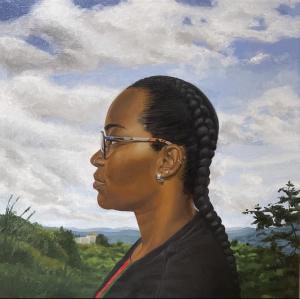
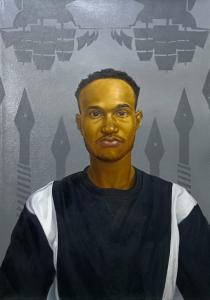
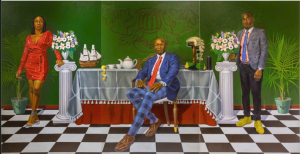
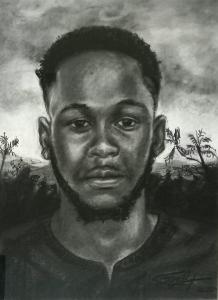
Artist Statement
The current progression of Greg Bailey's work pivots around the contemplations of identity, blackness and the formulation of self-awareness, space and how postcoloniality as a construct, persist in the present-day Caribbean. His work addresses these matters by using traditional drawing and painting techniques to compose images of black people who are posed, clad and placed in different environments. These environments represent various situations of local, regional and global challenges that stare us straight in the face, and we must come to terms with them and navigate them with fervor and diplomacy. Bailey's works can be seen as environments that are imagined or observational and are primarily constructed from photographic reference of actual spaces. Either way, both types are used to engage the viewer with a wider conceptual framework that encompasses the overall ambition and discourse within each piece. The aim is to part-take in the act of documentation and storytelling with specific regards to how the Caribbean narrative, find relevance within the wider context of global discourses. His work therefore utilizes cultural mapping as a device, to interweave various materials from the myriads of influences that the Caribbean region experiences from around the world, and, reconstruct them in ways that explore particular narratives with contextual relevance and meaning about where we are, and or where we want to be.